What Oak Furniture Land’s Ads Teach Us About Trust

Jack Young
- Last Updated: 1 April 2026
The Gist — What Oak Furniture Land’s Knock “Test” Taught Us About the Psychology of Trust
Oak Furniture Land’s knock on wood ads turned a simple gesture into a national proof of quality. The brilliance lay not in proving a measurement but in psychology: the Illusion of Control, it played into our tendency to feel confident when we can act on uncertainty ourselves. By inviting customers to physically “test” the timber, the brand moved the conversation from a salesperson’s promise to the customer’s own hands.
In furniture retail, where purchases are rare and mistakes expensive, these permission-to-buy moments matter. Shoppers don’t just want reassurance; they want a way to verify it. Create tangible proofs: invite customers to run their hands along the grain, glide a loaded drawer with one finger, or compare timber cross‑sections. These small acts shift trust from claim to confirmation.
Stop asking customers to believe you; give them the means to prove you right.
The Knock That Helped Built a Brand
I’ve got to knock on wood…
Remember those Oak Furniture Land ads—the ones that subtly encouraged you to literally knock on wood to test the quality?
I always found them odd. When the salesman knocked on the surface, it almost felt superstitious, as if he were warding off bad luck. “No veneer in ’ere… but knock anyway, just in case, as to not tempt fate.” It almost suggests there might be a veneer after all. To clarify, there wasn’t.
After these ads began airing, I remember people started knocking on tables themselves. Admittedly, I cringed a little.
Despite the quirk, those ads dominated UK TV recall, topping Campaign magazine’s 2019 Adwatch of the Year, turning a simple knock into national brand memory.
That knock wasn’t a scientific test, but it tapped into powerful psychology. It gave customers a tangible way to test the brand’s promise, making solid wood feel real, personal, and believable.
The Psychology Behind the Knock
Buying furniture is a significant investment, something most people do infrequently.
Because years often pass between purchases, every new shopping experience feels like starting from scratch. Most customers lack lasting knowledge about materials, build quality, or how to judge durability.
Oak Furniture Land’s campaign solved that uncertainty by giving shoppers a simple, tangible action that felt like a test of truth, one that didn’t age and could still be used years later. By physically interacting with the product and hearing that firm thunk, customers felt they were verifying quality for themselves. It eased the fear of getting it wrong, replacing doubt with a sense of personal control.
Psychologists call this the Illusion of Control: a bias where people overestimate their influence over uncertain outcomes. In a category where purchases might happen once a decade, that illusion isn’t trivial; it’s comforting.
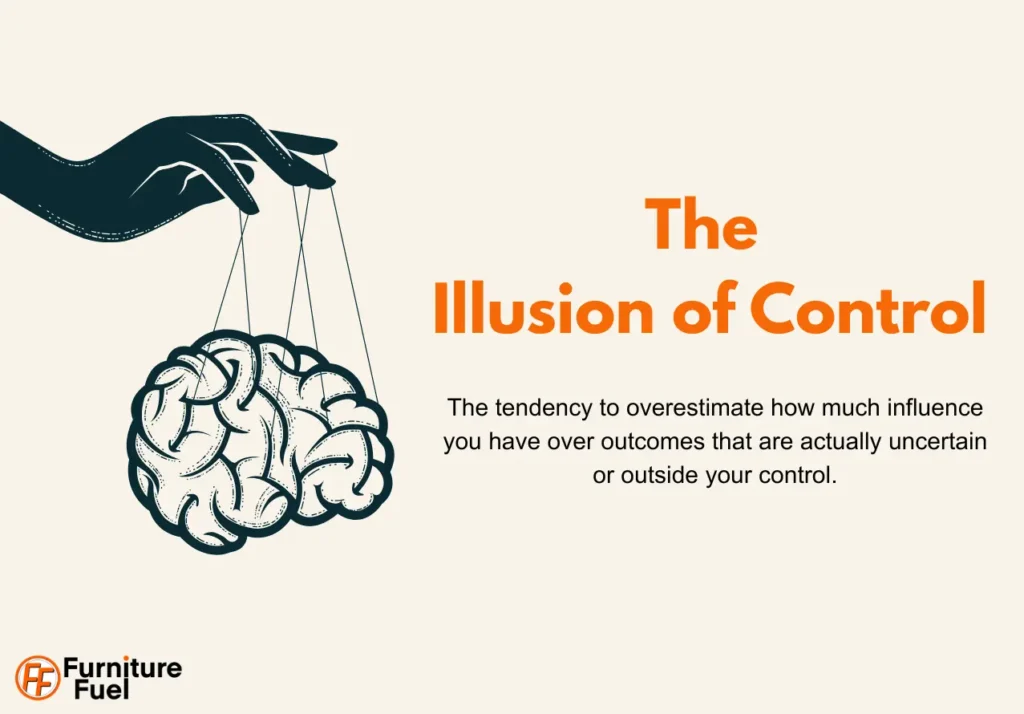
The knock didn’t actually test for veneer. It worked because the ritual felt like proof. It transformed a promise (solid wood) into a personal experience. Customers weren’t just being told what to believe; they were given the illusion of confirmation by using their own hands.
So, how can you apply the illusion of control in your own store? We touch upon tangible truths in our article on the Decompression Zone, the area at the entrance of your store where customers transition from the outside to indoors.
Tangible truths are not illusions, they are where you let the product speak for itself. The goal is to get customers to interact with your furniture to see the dovetail joints, the texture and the thickness of the timber.
This means that in your showroom. Don’t just say “this is solid wood.” Encourage them to:
- Run their hands along the grain
- Open and close drawer runners
- Lift cushions to feel the spring system
- Compare your oak finish against a competitor sample
The Weight Factor
During my retail days, I often watched customers lift tables and say, “Wow—that’s solid.” To them, weight equalled quality. Yet, as we know, weight alone can mislead; it might just be a thick composite core under veneer. Still, that heft creates what you might call an Illusion of Durability, a close cousin to the Illusion of Control.
While weight isn’t necessarily a bad selling point, make sure you back it up with transparency. Instead of simply claiming solid wood, show the truth. Display a cross-section of your timber beside a competitor’s inferior version. Don’t worry, you don’t even need to label the competitor. The contrast will speak for itself.
When Furniture Doesn’t Allow a Test Drive
One challenge in furniture retail, especially for high-ticket pieces, is the lack of a true test drive. Yes, customers can sit at a table or open a drawer, but that only offers fragments of the ownership experience.
The knock served as a simple cue that gave shoppers the permission to buy. It was a performance that allowed them to stop worrying and hand over the card.
You can build similar permission moments. For example, demonstrate the One-Finger Glide: show a fully loaded drawer that still slides smoothly with just one finger. It proves build quality and craftsmanship in a way customers can see and feel.
Trust Through the Expert Guide
Those ads always featured the same archetype: the older, knowledgeable salesman. He was reassuring and not pushy.
The fascinating part of these adverts was that although they often focused on the knock, it was rarely explained; no one said, “This proves it’s solid wood.” Instead, the act felt like an insider’s trick, a secret of the trade that only seasoned pros would recognise. Some Oak Furniture Land ads did explicitly call it “the knock test,” yet even then, it was only ever hinted that you wouldn’t want an echo; they never said, this is how solid wood sounds compared with veneer.
A thick veneer over MDF can sound solid when knocked, or a solid wood sideboard hollow when knocked over the cupboard section, but that didn’t matter. Customers weren’t concerned about the science behind it, as they trusted the guide showing them.
Your brand needs to become that guide. Start with detailed buying guides and “Our Picks” on your website. Use short videos to show differences in hinges, drawer runners, and finishes. Cover the topics you assume people aren’t interested in, like the difference between plain‑sawn and quarter‑sawn oak, or true quarter‑sawn oak and why one can give greater stability, but comes at a higher price. Those distinctions are exactly what buyers want from a trusted expert.
Transitioning from Expert to Customer Peer
I don’t recall the younger, “inexperience” salesman doing the knock, but later, customers themselves took over that role in the ads. It was a subtle but brilliant shift: from Authority to Social Proof.
When a customer knocks (and reacts with a smile), it seems like a referral. The ad is relating to you or mirroring you. You’re supposed to see yourself as that average shopper using the test.
The ultimate application of this in your business is customer advocacy and referral. Invite customers to record short clips in their homes, talking about their experiences with your furniture. Encourage them to show what they loved: the door catches that connect firmly, the smooth glide of runners, the warmth of timber in natural light. Simple, genuine demonstrations of satisfaction are more persuasive than any claim.
Don’t Leave Trust to Chance
The knock on wood “test” was a masterclass in psychological engineering. Maybe bordering on the darker side. It took a complex, high-stakes worry (“Is this worth the money?”), and distilled it into a single, satisfying action.
Now, I’m not suggesting you start your own physical test of proof. Before you know it, we will have videos of retailers doing an Eric Cantona kung-fu kick into a chest of drawers.
But as a retailer, your job isn’t just to stock quality furniture; it’s to provide the informational permission to buy that allows customers to prove that quality to themselves.
Whether it’s the One-Finger Glide on a drawer or the Radical Transparency of a timber cross-section, these acts of reassurance are what close the gap between a browser and a buyer.
Stop asking your customers to take your word for it. Give them the tools to prove it, and they’ll give you their trust.