What Menu Order Can Reveal About a Competitor's Strategy

Jack Young
- Last Updated: 29 June 2026
The Gist — How a Competitor's Menu Order Can Reveal Their Strategy
Successful furniture retailers don’t just look at a competitor’s flashy homepage banner; they read the commercial intent hidden in their main navigation menu. Paying close attention to what sits in the very first slot gives you an immediate clue into their active strategic focus, top traffic drivers, or highest-margin ranges. Menus matter because they should never be random; it is the fundamental tool for reducing friction and guiding customers. The most effective website layouts are the ones where data, not internal opinion, dictates the priority to ensure a completely seamless path to purchase.
What’s on the Menu?
Next time you are doing competitor analysis, don’t just look at the homepage banner or hero section. Look at the main navigation menu and pay attention to what sits in the first slot.
That first category is often an important clue to what the business wants customers to find quickly. It may reflect a high-priority product range, a key commercial focus, or simply the most efficient path into the site. But it is not proof of best sellers on its own.
The Psychology of Prime Digital Real Estate
Navigation is prime digital real estate. On desktops, especially, the far-left position is typically the first place a customer’s eyes land. It carries far more commercial weight than many businesses realise.
This leans on a well-known user experience (UX) and marketing principle called a heuristic—a mental shortcut. Because we read left to right, our brains naturally prioritise top-of-page and leftmost placements. If a retailer follows standard UX practices to create a frictionless sale, that first category is never chosen at random.
The driving force behind that primary position could be anything from high organic traffic volumes and seasonal campaigns to active customer demand or an internal strategic push. So, while menu order should never be treated as a perfect representation for revenue, it can still reveal what the retailer wants to put in front of or what they want customers to notice first.
The IKEA Example
If we look at IKEA as an example, we see that the first menu item is offers. However, using the Internet Archive, I can see that just 10 days ago, it wasn’t. It was the current number two on the menu, storage furniture. We can interpret this as IKEA’s focus on promoting the offers section. These offers last until the 12th of July, so we should expect to see storage furniture return to the first position.
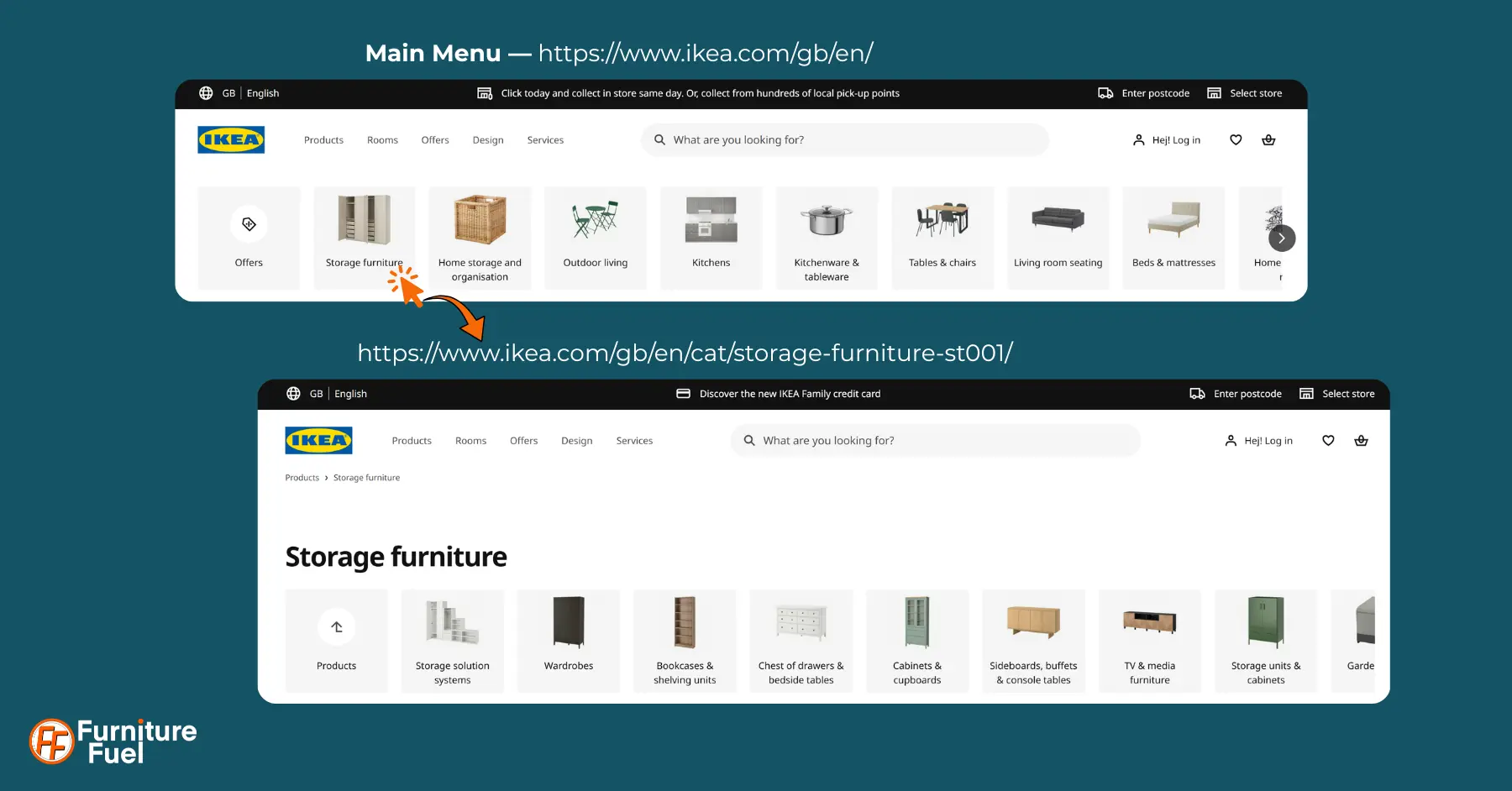
Screenshots taken from IKEA.com.
SEO software doesn’t have direct access to Google’s internal traffic data, and so it is an algorithmic estimation of traffic. However, using it to assess IKEA’s traffic and removing the number one traffic domain, which is the homepage. In the following 10 highest visited URLs for IKEA (https://www.ikea.com/gb/en/), 6 out of the 10 are storage furniture products.
Coincidence? Maybe.
What Triangulation Signals to Look For
Menu order becomes far more useful when you read it alongside other signals. Look for consistency across the menu, the homepage hero, social content, and search landing pages. When the same category appears in all four places, you are likely seeing a deliberate commercial priority.
That is where the insight gets stronger. One signal can mislead you. Three or four signals together start to tell a coherent story.
The Pattern in Furniture Retail
In furniture retail, this pattern is easy to spot. Sofa-led brands almost always lead with sofas because that category sits at the absolute centre of their offer. Other multi-category retailers may lead with living room, bedroom, dining, or a sales event, depending entirely on what they are commercially prioritising at that moment.
Again, that does not automatically mean the first item is their top-selling category by volume or revenue. But it tells you precisely what they want to make easiest to find, and what they want to bring into the customer’s view first.
How to Run a Coordinated Mini Competitor Audit
If you want to use this insight properly, run a focused competitive audit. Look at 5 to 10 competitors in your niche and map out:
- Their first navigation item.
- Their homepage hero message.
- Their most prominent organic social content.
- Their top organic landing pages (if you have SEO tools available).
If the same category keeps appearing across all four areas, that is a definitive sign of strategic focus. If it does not, that is equally useful data. It often exposes a friction-inducing gap between what the brand claims it is prioritising and what its website actually guides users toward.
A word of caution on competitor analysis. Knowing what a competitor is prioritising is not an invitation to directly copy. They may be performing tests of their own and, based on the insights gained, go in an alternative direction.
The better response is not to blindly copy a competitor, but to ask where you can create a clearer or stronger offer for your own customers.
Testing the Theory on Your Own Website
There is a direct practical lesson here for your own business. If you want to promote a specific category, perhaps a high-margin bedroom range that deserves more attention, test moving it into slot one of your menu.
Monitor the data closely: watch the shift in clicks, enquiries, and ultimate conversions. The goal is to measure whether making a range physically easier to find leads to better commercial outcomes. This is a brilliant way to build visibility for ranges that aren’t yet getting the attention they deserve.
The Mobile Factor: Remember that on mobile devices, your horizontal navigation will compress into a hamburger menu. Because mobile users frequently prefer scrolling down a page over tapping open menus, your homepage hero section becomes your main driver for attention and action. If you shift slot one in your menu to prioritise a range, make sure your mobile hero section mirrors that change so mobile browsers see the priority instantly.
The Real Commercial Lesson
Menu order alone does not tell the full story. But it can be an incredibly useful clue about what a retailer values most, what they want customers to notice first, and where they are actively trying to reduce friction.
Used properly, it becomes a core part of a wider, robust competitive analysis that bridges the gap between the hero banner, social promotion, and performance data. Used carelessly, it simply becomes just another internal assumption.
So, the better question to ask of your competitors is not merely, “What is first on the menu?”
The real question is: What story is the business trying to tell across every single channel, and what does that reveal about their true commercial priorities?