Why the "What Happens Next?" Flowchart Could Save the Sale

Jack Young
- Last Updated: 17 March 2026
The Gist — Why the "What Happens Next?" Flowchart Could Save the Sale
To eliminate post-purchase anxiety and “Where is my order?” enquiries, furniture retailers should implement a Japanese-inspired “What Happens Next?” flowchart on product pages. This low-tech, high-impact tool allows customers to mentally rehearse the journey, and either confirm expectations or correct timelines.
How Unspoken Expectations Kill the Sale
When we order anything, whether online or in-store, we have deep-rooted expectations of how the process should go. These expectations are built through thousands of previous purchases; we are professional consumers with a lifetime of experience.
In furniture retail, the expectation is usually a wait. Whether it’s 48-hour delivery for an in-stock bedside table or a 10-week lead time for a bespoke sofa, managing that wait is notoriously difficult. Our brains often operate on a sort of buying autopilot; we assume the experience will be like any other, until it isn’t.
There is incredible value in either confirming or correcting what a customer believes will happen.
- Confirming: Reinforces their belief that they are in safe hands, allowing them to relax.
- Correcting: Prevents the friction and complaints of unmet expectations.
If you don’t correct a customer’s internal timeline, you pay for it in “Where is my order?” phone calls, frustrated emails, and a broken contract that was never made by you but is etched in the customer’s memory.
How a Post-Purchase Flowchart Saves the Sale
In the book Making Websites Win, the authors discuss a method used by Japanese companies: The Flowchart.
Japanese consumers expect to be shown exactly what they are going to get. Which is why you see hyper-realistic models of meals outside restaurants. Similarly, Japanese websites use flowcharts to show visitors exactly what happens after they say “yes.”
The infographic influences “Future Pacing.” It allows the customer to mentally prepare for the journey ahead to the point that it is in their home.
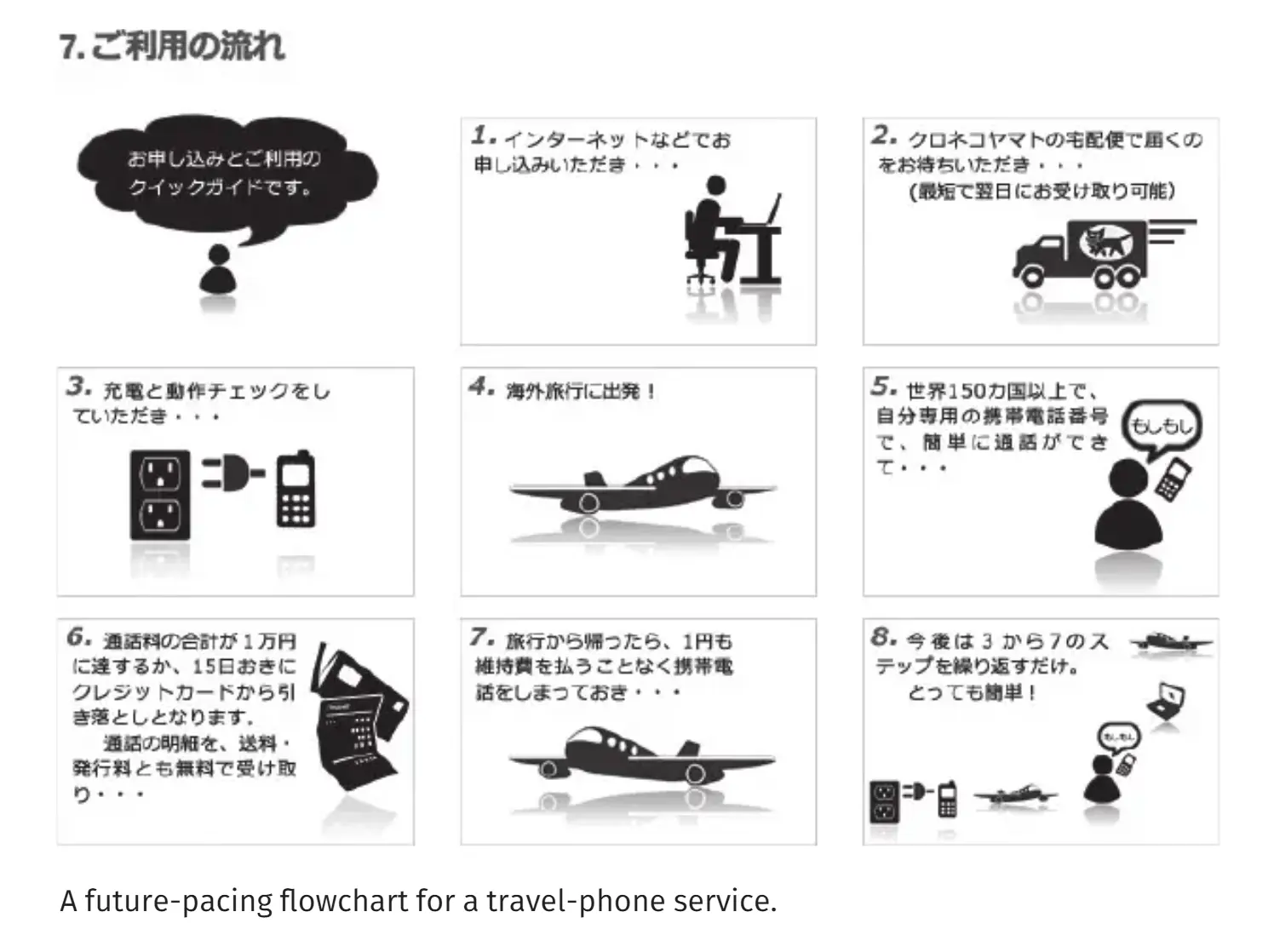
Image: Flowchart taken from Making Website Win.
This is an example image taken from the book on pg. 198, showing the company Mobal, which uses a flowchart to show the journey of a travel phone:
“The flowchart makes it clear how the process works: the order is placed, the phone is delivered, the phone is charged, the person flies abroad, calls are made, Mobal sends an itemized bill, the person returns home, and then the whole process is repeated for subsequent trips.”
Making Websites Win is a fantastic resource, full of information beyond just the flowchart. I’ve mentioned it before in my NPS articles.
Why You Should Implement a Flowchart on Your Product Pages
Most B2C furniture sites are brilliant at the product selection phase, but go silent on the fulfilment phase. This can make it seem to the customer that you do not care about them, the moment the payment clears.
The static flowchart wins because:
- It’s “CRM-Agnostic”: You don’t need fancy tech. It’s one JPEG or SVG file that works for an independent shop or a national chain.
- It Manages Anxiety: When a customer sees Step 2 is “Quality Check,” a 2-week lead time feels like diligence, not a delay.
- It Scales: It’s a one-time design investment that pays dividends on every single product page.
How to Implement the Flowchart in Your Furniture Business
This doesn’t have to be complex. While you could have this in a customer dashboard where each section lights up when it gets to that stage, as a type of live tracking. The low-tech, high-impact option for most independent retailers is a static image placed on every product page.
It simply explains: This is how we get a wardrobe from our warehouse to your bedroom after you check out.
Now you may need two versions, one for collection and another for delivery.
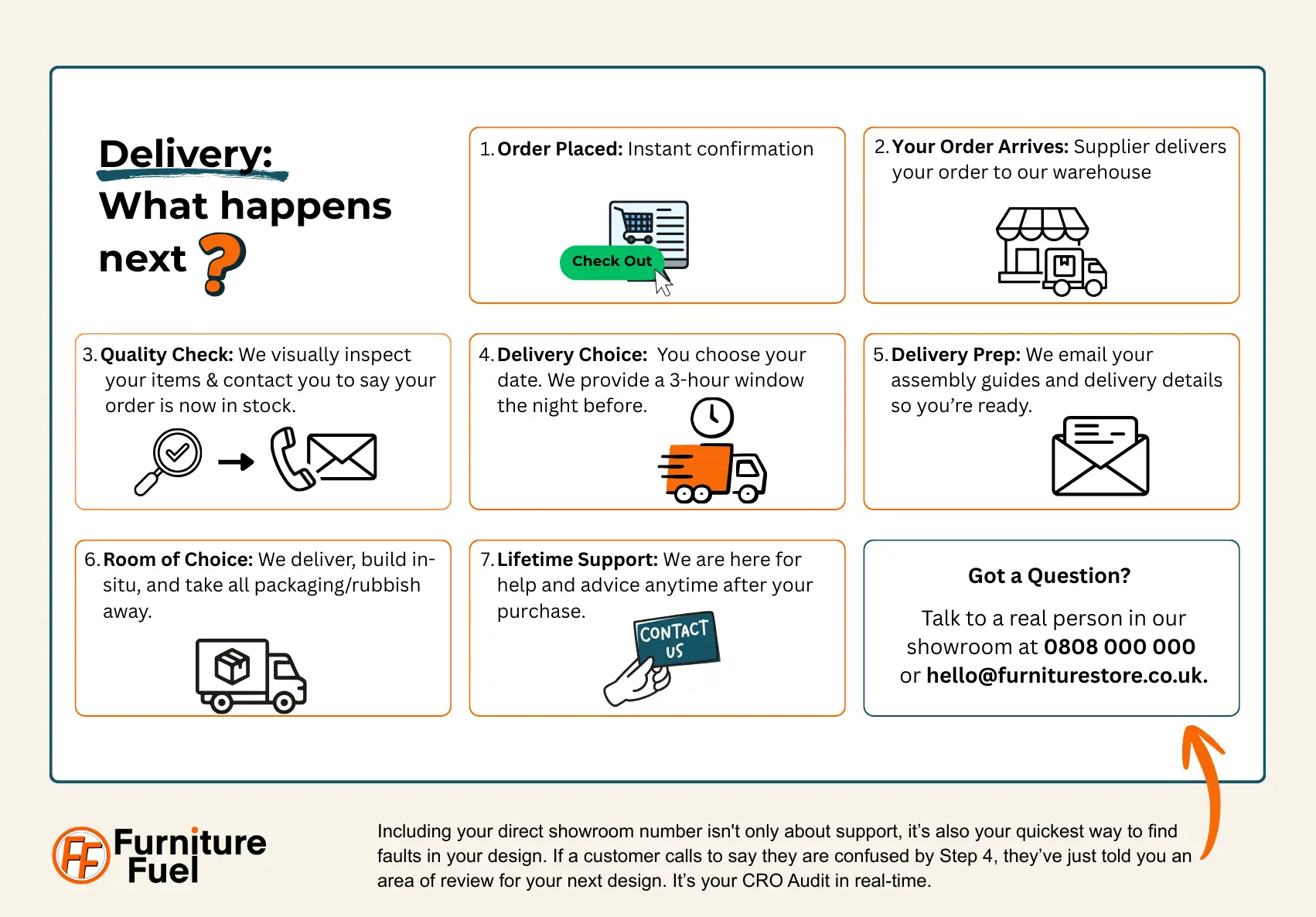
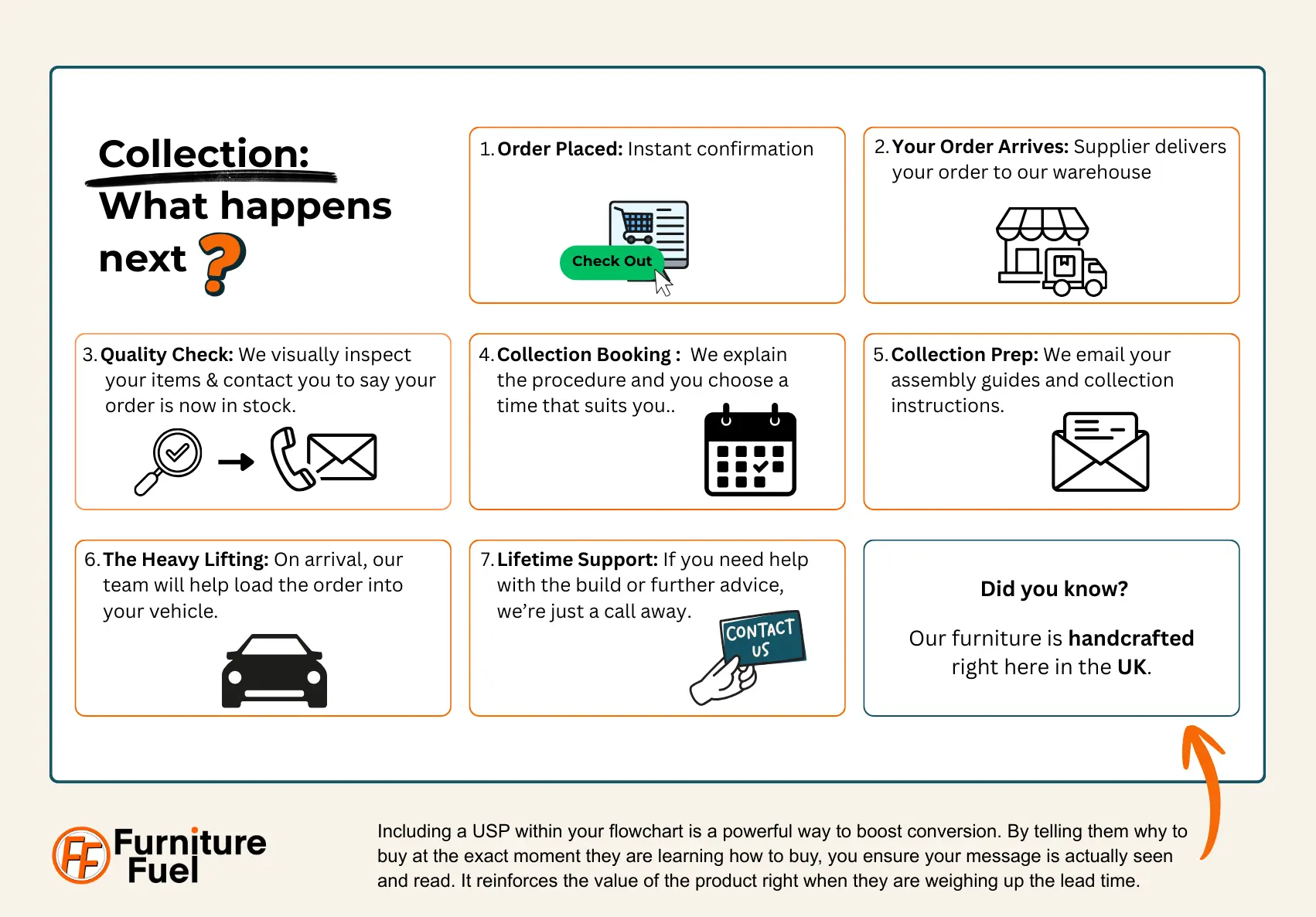
The layout of your flowchart will depend on your specific journey. It is a fine balance between being informative and causing information overload. I recommend erring on the side of caution and keeping the design relatively monotonous (don’t let the colours distract from the message). But there is always room for testing.
Oh and monotonous doesn’t mean boring or low-quality. Use a single brand colour to highlight the path. It shouldn’t be a rainbow, but it must look intentional.
Regardless, the purpose of the flowcharts defined in Making Website Win is:
- They answer the questions that the visitors are asking: “If I order this product or service, what will happen next? What will be the process I follow?”
- They allow the visitors to rehearse mentally the process of using the service, visualizing it as being part of their lives.
So, this should be the North Star for your design.
Notice Step 5 in the flowchart. This is where the map moves from process to purpose. As I’ve discussed before regarding building customer loyalty, loyalty is built and sustained long after the sale.
The first physical step is ensuring the product is delivered, assembled, and set up perfectly.
Testing Your Design
The beauty of this idea is its testability. You don’t have to overhaul your entire site. Try it on a sample of product pages. If you see a lift in conversion or a drop in pre-delivery enquiries, roll it out.
You can even experiment with the video. As authors Blanks and Jesson suggest, you may find value in turning your image into a video.
My recommendation is that it should feature your actual warehouse team, your branded vans, and your showroom staff, wherever possible. Doing so can build immense Online Trust. Just remember, people will forgive a low-quality video, but they will never tolerate bad audio.