Why Furniture Customers Aren't Loyal & How to Fix It

Jack Young
- Last Updated: 18 March 2026
The Gist – Loyalty Isn't Dead, Just Redefined
You’ve felt the shift: customers treat your showroom floor like a gallery for inspiration, then hunt for a better price elsewhere. It feels like loyalty has vanished, but in reality, it hasn’t; it just needs to be redefined and reactivated.
In low-frequency, high-ticket categories like furniture, most retailers mistake habit for loyalty, instead of focusing on attitudinal commitment built through pre- and post-purchase value.
For independent furniture retailers, this means you must:
- Redefine loyalty by behaviours that matter: Track Second Room returns, referrals, preference over price—not just frequency.
- Weaponise post-purchase: Turn delivery black holes into trust amplifiers with personalised check-ins, care content, and feedback loops.
- Build mental availability during dormancy: 80/20 keeps you salient for years between purchases—education over “Shop Now.”
- Escape commoditisation: Solve Jobs-to-Be-Done, build trust barriers, ditch tired adjectives.
Get loyalty wrong, and you’re just a transactional pit stop. Get it right, and customers will defend your brand while your competitors fight over margin scraps.
Table of Contents
Why There Seems to Be Fewer Loyal Customers
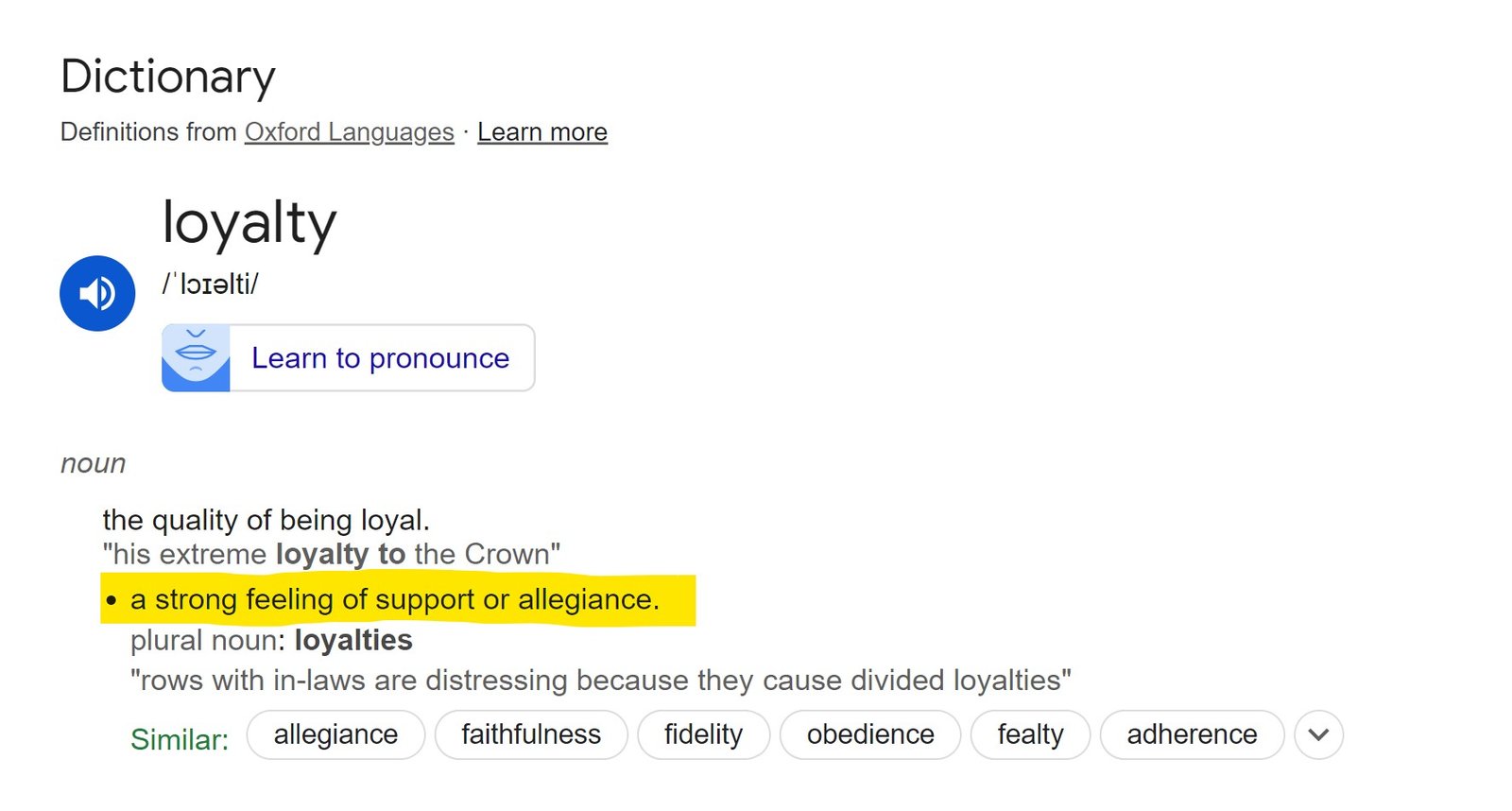
Image: Screenshot of Google Search Results for Loyalty
You’ve probably thought at some point that customer loyalty no longer exists or, at the very least, has drastically decreased over the years. Loyalty has indeed decreased from the good old days. But it’s complicated.
One major problem is the oversaturation of the furniture market. Many new businesses are entering the market, most selling the same product as other established furniture retailers, creating me-too businesses, which puts the buying power in the customer’s hands.
When all retailers start to look the same, they become one. There is no real reason to be loyal to one when they all offer, to an extent, the same product and the same service.
This is compounded by suppliers whose offerings look indistinguishable from one another. Sometimes this is accidental, two separate companies producing what the market wants. Other times, a supplier sees a range doing well elsewhere and decides, “I want some of that.”
With technology providing easy, instant comparisons, loyalty isn’t a given. In an industry where multiple similar options are just a click away, we have to ask: In this environment, why should the customer be and stay loyal to you?
This article is about how to design that loyalty deliberately in a commoditised, low-frequency category like furniture.
What Defines a Loyal Customer?
Defining a loyal customer in the furniture industry is a bit like asking what makes a high-quality product; it’s not just about how it looks on the showroom floor, but also about how it stands up to years of daily use.
There are two main types of loyalty: behavioural and the one that I find hard to pronounce the first-time round, attitudinal.
- Behavioural Loyalty is, in essence, buying out of habit. You buy from a business because it’s local or because “it’s what you’ve always done.” But the moment the customer becomes aware of a better-deemed offer, they switch.
- Attitudinal Loyalty is intentional. The customer knows why they are buying from you, and that reason matters to them more than any other offering.
I’d argue that most retailers mistake habit for loyalty. When that shopper eventually goes elsewhere, the retailer is left wondering: “What happened? People just aren’t loyal anymore.”
The Definition of a Loyal Furniture Customer
A loyal customer is someone who has moved beyond a purely transactional relationship and entered a mutually supporting relationship. They don’t just buy from you; they support, praise, and defend you. But they also largely ignore your competitors.
In furniture retail, they can be defined by three distinct behaviours:
- Preference over Price: They will wait for your lead times or pay a slightly higher margin because the trust and past experience outweigh the “quick fix” of a cheaper, unknown competitor.
- The Second Room Rule: They return to you for different rooms or categories. If they bought the sofa and had a positive experience, they come back two years later for the dining set without starting a fresh search for a retailer.
- The Referral Engine: They are the active participants in your Advocacy Loop. They are the people who, when asked, “Where did you get that chair?” by a friend or family member, don’t just give a name, but tell a story.
The Freshness Paradox: A Thought
We often think, if it isn’t broke, don’t fix it, when it comes to floor displays. But consider this: are we doing our loyal customers an injustice by keeping the showroom static?
If a customer returns 12 months later to make a Second Room purchase and sees the exact same furniture in the exact same spots, the business can look like it’s standing still. While a 3-month gap is often still the “consideration phase” where people want to find what they previously saw, a year is a long time; people want styles to be relevant today, not 12 months ago.
It is not an easy thing to get right. There is always the risk of making things look temporary; customers want to know they can still get that matching bedside table. But by keeping the best-selling “anchors” and rotating the styling, accessories, and weaker ranges, you stay interesting rather than predictable.
The goal isn’t to confuse the customer, but to maximise saliency by ensuring your brand feels alive and current—not a time capsule.
Of course, your audience matters. A retailer selling low-end, functional furniture may find their customers are less prone to “showroom boredom”; in that space, utility and immediate availability often beat inspiration. However, for the mid-to-high-end market, where you are selling a lifestyle and a vision, staying interesting is a non-negotiable part of maintaining loyalty.
Why Repeat Purchase Can Be a Trap
In many industries, loyalty is measured by frequency. In furniture, frequency is naturally low. If we define loyalty solely by repeat purchases, we ignore post-purchase dormancy.
A customer who buys a piece of furniture and never talks about it again isn’t loyal; they are a past customer… a wasted asset.
True loyalty in furniture retail is mental availability, which is known as brand saliency. This is how quickly you come to mind when asked about a product need or a recommendation. These customers are the ones who remain ambassadors for your brand during the years they aren’t buying from you.
Why “Good” Customer Service Does Not Ensure Loyalty
“Good is the enemy of great”
- Jim Collins
There is a need to address a misconception of loyalty: that “good” customer service and a single successful sale are enough to ensure loyalty. This might seem obvious, but you would be surprised how many retailers expect a polite hello and a smooth delivery to turn a stranger into a lifelong advocate.
It would be reasonable to say that service is a differentiator, and it can be. However, friendly staff and “good” service are no longer differentiators—they are the baseline. They are expected. While you need them just to be considered by today’s consumer, they are not a reason for loyalty.
Customer Loyalty Is Based on a Relationship, Not a Transaction
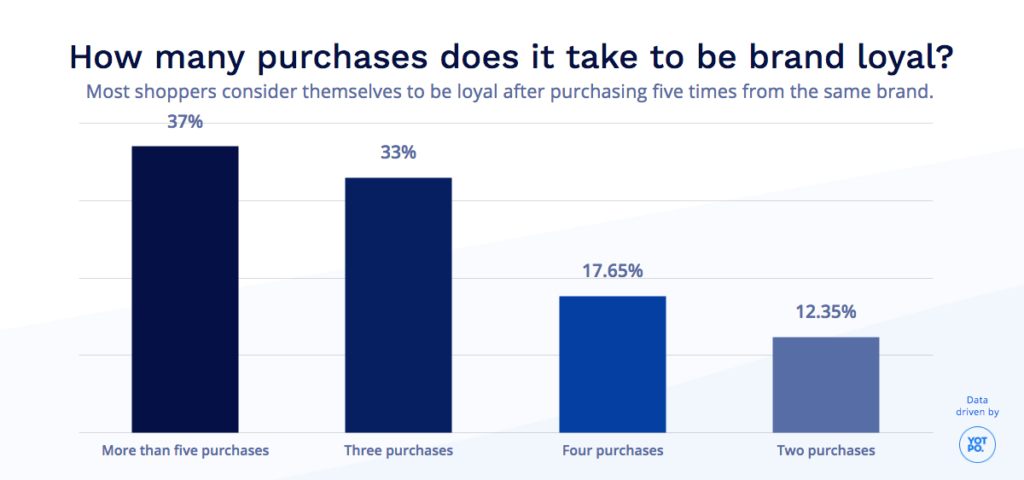
Image: Chart taken from Yotpo. How many purchases does it take to be brand loyal?
In the furniture Industry, the sale is often treated as the finish line. Once the delivery van leaves, the customer rarely hears from the business again, unless it’s a generic sales promotion.
Even if a customer follows you on social media, they are often bombarded with “Shop Now” banners rather than helpful advice, interior inspiration, or entertainment.
Yes, you should post promotional content. However, it must be used sparingly. A solid starting point is the 80/20 Rule:
- 80% Value-Building: Education, styling tips, care guides, and behind-the-scenes expertise, such as how the showroom is styled, or furniture packages for transport without a box.
- 20% Promotional: Offers, new range launches, and direct calls to action.
For example, instead of four “Sale ends Sunday” posts in a week, a retailer might share a reel on how to style a small living room, a showroom tour, a short “care mistakes to avoid” clip, and only then a clear promotion. Purely promotional content is one-sided. Loyalty is not.
If you want to go deeper into what to post and how often, we break down the 80/20 rule and more in our article on building a social media strategy foundation.
The 80/20 rule, also known as the Pareto Principle, suggests that roughly 80% of outcomes come from 20% of efforts. In marketing, 80% of your results—like customer engagement or sales—likely stem from 20% of your marketing activities. Applying this to content, it’s recommended that 80% of your communication focuses on providing value—through education, entertainment, or helpful tips—while only 20% should be promotional. This helps build trust and loyalty by focusing on the customer’s needs rather than constantly pushing sales.
How to Improve Customer Loyalty with Value
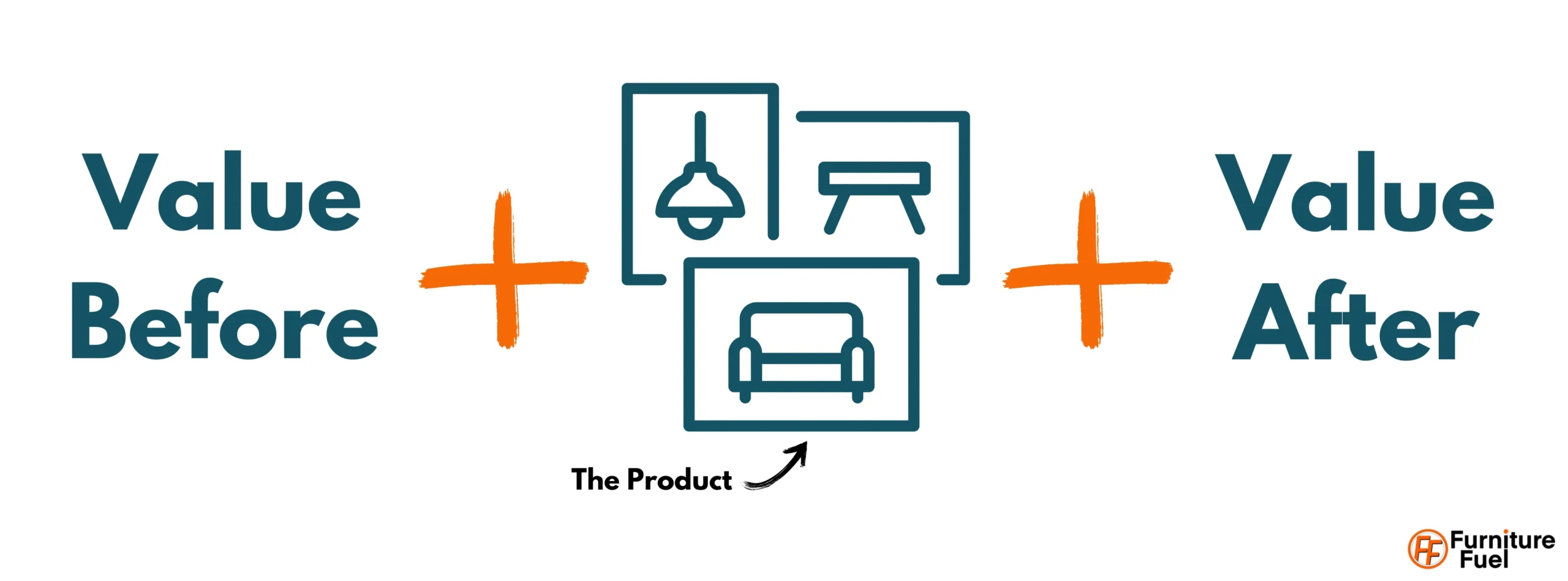
Supplying a product is only part of the overall value you can create for the customer. To build true loyalty, you must consider your total offering.
The product sits at the centre, but value is built in the layers before and after the purchase. Value added at these stages acts as a multiplier; it can amplify a positive experience or act as a sort of safety net if a customer received less than “good” service at another point in the process.
Below, we look at specific areas where you can add value. This is not a comprehensive list, nor do you have to implement every point to see results. The best approach is to identify the areas you can implement with relative ease, maximise their effectiveness, and then move on to the strategies that require more time, investment, or effort.
A Note on the Powerhouse Channel
You will notice that email is mentioned frequently in the following sections. Email is a powerhouse marketing channel at all stages of the buyer journey, but it is especially powerful for building loyalty during the post-purchase dormancy phase.
Important: Please always ensure you have the correct customer consent to send marketing communications beyond the standard transactional order confirmations or invoices.
How to Add Value Before the Customer Buys
Value isn’t just about the physical item; it’s about the experience surrounding it. If you want to see a specific example of how something as simple as a cup of coffee can enhance that experience and increase sales, see our article on Coffees relationship to increased furniture sales
Brand Story & Identity
Furniture is often, on the surface, a functional purchase. We buy it to store plates, to sleep on, or to sit on. However, we often overlook the emotional connection a customer has with the product—and, more importantly, with your business.
Whether it’s sustainability, craftsmanship, or supporting local communities, customers connect emotionally with brands that stand for something more than a transaction.
Are you helping customers align their purchases with personal values? Does your brand identity show up in your emails? Is there a purpose that resonates? Are you ensuring every touchpoint (social media, email, website) reflects these values?
Consistent storytelling builds the familiarity and trust required for a customer to feel connected before they ever hand over their credit card.
Personalisation
Personalisation is normally regarded in the use of data to understand customer preferences and serve them personalised content based on their needs or interests. But true personalisation isn’t just about algorithms; it’s about understanding the shared aspirations of your audience. While data can help with product recommendations, real value comes from solving problems.
Value-first content, for example, the act of sharing guides on interior trends or tips for maximising space in a small flat, helps the customer solve the “Job to be Done” before they even consider a purchase.
This content is most effective when written in the voice of the customer. Use keyword research to understand search intent, but don’t ignore your best resource—the people on your showroom floor, customer yes, but also the sales team. Ask them what their pain points are and create content that addresses them.
The Jobs to Be Done (JTBD)
The Jobs to Be Done (JTBD) framework, pioneered by Tony Ulwick and later popularised by Clayton Christensen, suggests customers don’t just buy products; they “hire” them to achieve an outcome in their lives. You might own the table, but the real reason you chose it was to host Sunday roasts.
The “job” often endures longer than any single product. A family might replace their dining table every few years, but they keep “hiring” something to help them gather everyone around the same space. When you design your content and service around that job, the product stops being a commodity, and you stop being just another shop.
Engagement & Community Building
When we hear the word engagement, we first think of social media engagement—how engaged our followers are. Engagement is more than just a like; it is the act of having a conversation. Responding thoughtfully to comments and questions suggests you are genuinely interested in what your customers have to say.
One of the most powerful ways to engage is through Education. When you educate customers about your product, materials, usage scenario or user stories, builds trust and credibility. You are helping them buy, not just selling to them.
The Will-It-Fit Guide, for example, is such a valuable tool for both you and your customers and is fast becoming an industry standard, but most are generic. Use your experience to create a downloadable, printable guide that helps customers measure hallways, door frames, and corners.
A content gap I haven’t seen any furniture business fill yet: A car-space measuring guide. Nothing kills the post-purchase high faster than a customer arriving to collect a chest of drawers only to realise it won’t fit in their hatchback. This frustration is then amplified by having to wait several days for delivery. Creating a guide for this solves a massive frustration before it happens.
Industry observations, actionable findings, and the occasional unfiltered rant that doesn’t make the articles.
How to Add Value After the Customer Buys
The focus in furniture retail is usually on convincing or persuading a stranger to choose your product. However, real loyalty is built and sustained after the sale, when the customer sees how your business supports them in living with and enjoying that product.
Post-Purchase Support & Communication
Don’t let the post-purchase wait become a black hole of silence. Use this time to give the customers stories to tell and to build trust.
Initial Post-Purchase Emails
Send a personalised email thanking the customer for their purchase. You can remind them again of the lead times, the best contact information for updates, and what will happen when the product arrives.
Delivery or Collection
When the order arrives, don’t just book a slot. Send a Delivery Guide or a quick video. Advise them to clear the hallway or remove rugs that might be trip hazards. Provide links to setup videos or product care tips specific to what they bought.
Check in with the customer after the product has been delivered and ask if everything is set up and as it should be. A simple “hope everything is okay” email can dramatically change their perception of the experience. Again, link the guides relevant to them and their purchase.
The Margin vs. Loyalty Trade-off
Yes, a follow-up might prompt a customer to mention a small scuff they were going to ignore. You might lose a bit of margin fixing it, but you win the relationship. If you aren’t willing to support them, why should they support you with their loyalty?
Don’t let all future business with the customer be clouded by this single sale issue. When you help the customer resolve their post-purchase issues, the customer now knows they can rely on you if anything goes wrong, increasing the chances of repeat purchase, which is worth more to your business than the cost of fixing the problem.
Feedback & Involvement
In our article on building a brand, we discuss Shared Ownership: Co-creating Brand Integrity. This is where your brand becomes resilient by actively listening, but listening with a strategic ear.
Ask for feedback not just on the product but on the entire customer journey. Show customers you’re interested in improving their experience, not just gathering reviews.
The Net Promoter Score can be a simple, beneficial way to collect customer feedback.
Consider including customers in future product development, allowing them to vote on new designs, colours, or product features. This involvement makes them feel valued and gives you first-hand data on what your customers are looking for. Which reinforces the personalisation discussed in post-purchase layers.
A word of caution with feedback, though. Henry Ford allegedly said, “If I had asked people what they wanted, they would have said faster horses.” If you ask customers what they want, they’ll describe your competitor’s features. Instead, ask for their pain points. Don’t look for their preferred solution; look for the problem they are trying to solve. This is how you avoid becoming a me-too copycat.
Net Promoter Score (NPS) is a popular metric that measures customer loyalty and satisfaction by asking customers how likely they are to recommend a company, product, or service to others. Respondents answer on a scale from 0 to 10, with scores categorising them as Promoters (9-10), Passives (7-8), or Detractors (0-6). The NPS is calculated by subtracting the percentage of Detractors from the rate of Promoters, providing an overall score that indicates how well a company is performing. It’s a simple yet powerful tool for gauging long-term customer sentiment.
Ongoing Engagement
To stay salient (top of mind) during the years when a customer isn’t buying, you must stay helpful.
Send content that matters, that helps customers get the most out of their product, such as “How to Prepare Your Solid Oak for Winter Heating”. Or send a “Happy Home Anniversary” message one year after their purchase.
In another article on Strategic Sales, we suggested giving loyal customers early access to Boxing Day sales in October. It builds the relationship and helps your delivery team manage the January rush.
The Foundation of Confidence
You will have noticed a crossover. Many of the value-building elements we’ve highlighted as pre-purchase or post-purchase actually work in tandem to reinforce each other. However, do not overlook the structural elements that dictate both pre- and post-sale confidence:
- The Value Proposition: Is it clear why they should buy from you and not the shop down the road?
- Site Architecture: How user-friendly is your website? If the menu order is illogical, friction wins.
- Social Proof: Reviews, Awards and user-generated content are external audits of your credibility.
- The Safety Net: Returns policies and guarantees are the ultimate post-purchase insurance policies.
Why After-Sales Is Arguably More Important
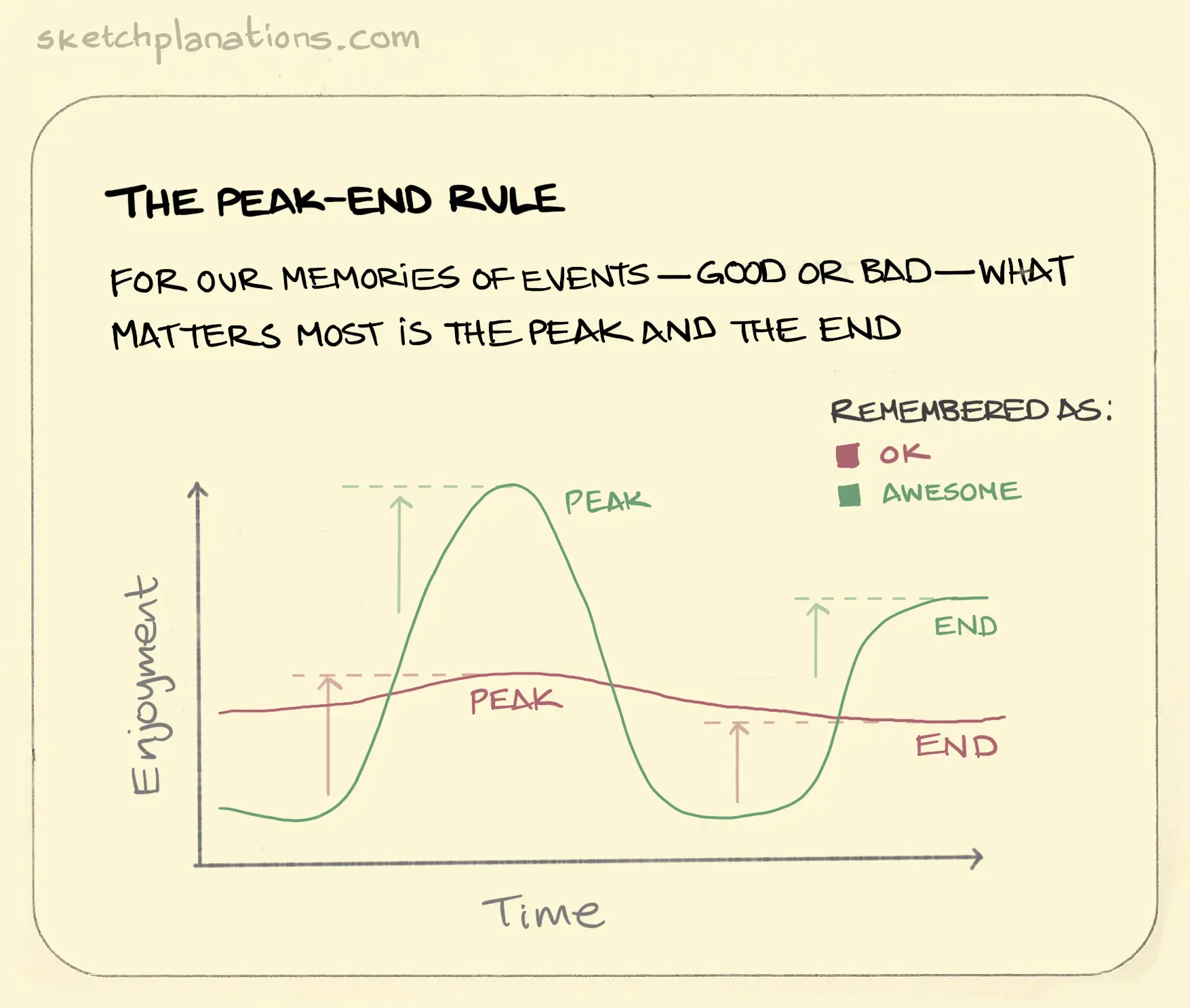
Image: Jono Hey, Sketchplanations
A customer’s last impression of your brand is often their strongest memory. This isn’t a theory, but a psychological heuristic called the Peak-End Rule.
According to this rule, people don’t judge an experience by the average of every second spent with you. Instead, they judge it based on two points: the Peak (the most intense emotional moment) and the End.
A heuristic is a mental shortcut or rule of thumb that helps people make quick decisions and solve problems without a detailed analysis. While heuristics are often efficient, they can sometimes lead to errors or biases because they simplify complex information. They are commonly used in everyday life, such as guessing the answer to a problem based on experience or using intuition to make choices when time or information is limited.
Identifying the "Peak"
The peak isn’t always the point of purchase. It varies depending on the journey:
- The Purchase Peak: For many, the high point is placing the deposit, the relief of finally deciding and the excitement of the new.
- The Discovery Peak: For others, it’s the “Aha!” moment when they find the solution to a long-standing pain point.
- The Value Peak: Sometimes, the high point is an info-rich article that helps them choose the right timber, aligning with their personal values of craftsmanship or sustainability.
The "End" is the Loyalty Maker
The Peak-End Rule suggests that the end of an experience is what people remember more strongly. If the after-sales experience is neglected or negative, it can leave a lasting bad impression that cancels out the positive peak from the sale itself.
Equally, a well-crafted end can actually soften the memory of minor hiccups earlier in the process. This makes the post-sale phase one of the most essential parts of the journey, potentially more important for long-term loyalty than the pre-purchase or immediate purchase phases.
The Point of No Return
While a great ending can fix a mediocre middle, it cannot always fix a Negative Peak. Significant breaches of trust, major product flaws, or truly terrible service create a spike of negative intensity that is “stickier” than any positive moment or end. In these cases, loyalty recovery requires far more than an apology; it requires a complete rebuild of the relationship, which ultimately may not recover.
Loyalty Building During Low Sale Periods
When the economy tightens, the instinct is to slash prices. However, data suggests that even in a downturn, price is rarely the only factor. According to The Drum, consumers prioritise:
- Product/Service Quality (69%)
- Convenience (59%)
- Customer Service (45%)
These factors are cited as more important than price when making purchase decisions. This proves that focusing on refining your service, simplifying your convenience, and proving your quality isn’t just a fair-weather strategy. It is your best defence, no matter the economic climate.
The Dangers of Lost Hope
The pressure for immediate revenue is real, but it often leads to fear-induced tactics: steep discounts that devalue your brand or cutting corners on quality to protect margins. While these might solve a cash-flow problem this week, they erode the trust and uniqueness you’ve spent years building.
The key is Balance. You can drive immediate revenue without sacrificing your long-term vision.
Short-Term Wins vs. Long-Term Relationships
Customer-centricity and revenue-generation are not mutually exclusive. You can implement “Quick Wins” to generate cash while still laying the groundwork for the Advocacy Loop and long-term loyalty.
If you run a limited-time promotion to drive footfall, don’t let it end at the till. Pair that discount with a personalised follow-up offering tips on product use, fostering a longer relationship with those same customers. Use the sale to acquire the customer, then use the post-purchase experience to keep them.
The Cost of Not Building Loyal Customers
The cost of acquiring a new customer is significantly higher than retaining an existing one. In survival mode, a high churn rate—losing customers as fast as you find them—can be fatal.
In the same The Drum article, it states that “Yet more than six in 10 (63%) say they will pay more to shop with the brands they’re loyal to.” Remember, loyalty is a two-way street; give them a reason to be loyal.
If you ignore the customer experience to chase immediate profits, you are forced into a constant, expensive cycle of buying new leads through ads. Nurturing current relationships, even through low-cost efforts like purchase anniversaries or style tips, increases repeat purchases and referrals.
Ignoring loyalty to solve a short-term cash problem is like burning your furniture to keep the showroom warm. It works for an hour, but you’ll have nothing left to sell tomorrow.
Does Customer Loyalty Still Exist
The modern furniture shopper is cynical. They have been promised “Luxury” by budget chains and “Expertise” by someone just cutting their teeth. When expectations consistently fail to match the experience, customers stop looking for a brand to love; instead, they just look for the lowest price or the fastest delivery.
As renowned Harvard Business School professor Youngme Moon argues in Different: Escaping the Competitive Herd, when every brand uses the same language, nothing stands out. In furniture, phrases like “well-made,” “handcrafted,” and “built to last” have become background noise in the customer’s mind; if everyone says it, no one believes it.
If loyalty feels like it has disappeared, it’s usually because your offer has blended into that background. You’re competing with a market that already has fixed characteristics in the customer’s mind.
The customer “knows” what furniture retail looks like. Unless you say and prove something meaningfully different, you inherit the same lack of credibility. So, your job then is not to shout louder; it’s to give customers a clear reason to care, remember you, and come back—even when they could buy anywhere else.
Selling Security in an Uncertain Market
We think we are selling furniture, but in a high-ticket, high-anxiety industry, we should be selling security.
With long lead times and “some assembly required” disappointments, loyalty is built on the layers of trust that surround the product:
- The Expert Guide: Salespeople who actually help the customer buy, rather than just closing them.
- The Bold Guarantee: Backing up “well-made” with a warranty that actually means something.
- The Safety Net: A returns policy that removes the fear of a miss-purchase.
Is it Worth the Hard Work?
Yes, you can build loyalty, but it isn’t a quick fix. It’s a constant treadmill of differentiation by innovation. The moment your unique value becomes the industry standard, you have to innovate again.
It sounds like hard work because it is. But in a market where everyone is shouting the same tired adjectives, the retailer who builds a moat of trust—and actually helps customers buy—is the only one who survives the cynicism.