How QR Cards Can Support Furniture Customers Long-Term

Jack Young
- Last Updated: 12 June 2026
The Gist — How Can QR Cards Support Furniture Customers Long-Term
Great furniture brands don’t just win trust at the point of purchase—they preserve it after delivery. A QR card gives customers a fast, tangible way to verify care instructions, assembly help, warranty details, or spare-parts guidance exactly when they need them. That matters because in furniture retail, confidence is rarely built by promises alone; it’s built when customers can prove the brand still has their back months or years later. The best aftercare is the kind that feels simple, immediate, and quietly reliable.
The Perfect Sale (and What Happens Next)
The customer has finally made their decision, and out of all the furniture stores available to them, they have chosen you. They invest in a 4ft 6in oak bed, matching bedside tables, and a premium mattress. It is delivered seamlessly, there are no follow-up complaints, and you assume the customer is delighted.
But even in this perfect scenario, the moment your delivery team leaves, a ticking clock starts.
Fast-forward three years. The customer is moving house and needs the assembly instructions to dismantle the bed frame safely. Or perhaps a glass of red wine is spilt on one of the oak bedsides, and they urgently need the care guidelines. Where are the original documents that arrived with the furniture? They are either buried at the bottom of a cluttered kitchen drawer or, more likely, thrown out with the packaging on delivery day.
What happens next?
The customer faces a choice: turn to the internet or turn to you.
If they call your showroom, your team’s time is pulled away from daily operations and fresh sales to hunt through old manufacturer files or email a supplier for legacy PDFs. If the customer turns to Google, the risk is even higher. They might find an incorrect, generic guide that damages the wood, or worse, they land on a competitor’s website that has the information easily available. In that moment, you haven’t just lost share of mind—you’ve handed a loyal customer directly to a competitor.
The QR Card Solution
True customer loyalty is built when you look after the customer years after the invoice is paid, not just until the delivery signature is signed.
The solution to this long-term support gap could be surprisingly simple: a durable QR card, or a small set of cards tailored for different purposes, delivered alongside the furniture.
These cards are housed in a clear, adhesive plastic pouch. They can be stuck discreetly to a hidden area of the furniture, such as the inside face of a drawer, underneath a tabletop, or on the back panel of a cabinet. Alternatively, they can be handed to the customer unstuck, allowing them to place the pouch exactly where they feel they will remember it best.
While giving the customer a choice is excellent service, there is a strong operational argument for establishing strict, store-wide rules for placement instead. A standardised location means your delivery teams know exactly where to apply them, and your customer care team knows precisely where to direct a caller years down the line.
Whichever placement approach you choose, the QR card transforms a static piece of wood or fabric into a permanent, direct line back to your business. It is a surprisingly low-cost solution to execute, yet it represents a level of care most retailers simply don’t provide post-sale.
Choosing Your Approach
The QR card strategy isn’t a rigid system. It can be a single, all-encompassing card or a set of tailored inserts; it is entirely about self-selection based on what your audience values most and what your team can deliver consistently.
Different tiers come with different operational demands and cost outputs, meaning cost-conscious independent retailers do not need to worry about expensive, overly complicated technology. However, it is always worth remembering that an upfront cost is actually a long-term investment if it measurably improves the customer journey, drives future advocacy, and protects your bottom line.
The Single Hub Model
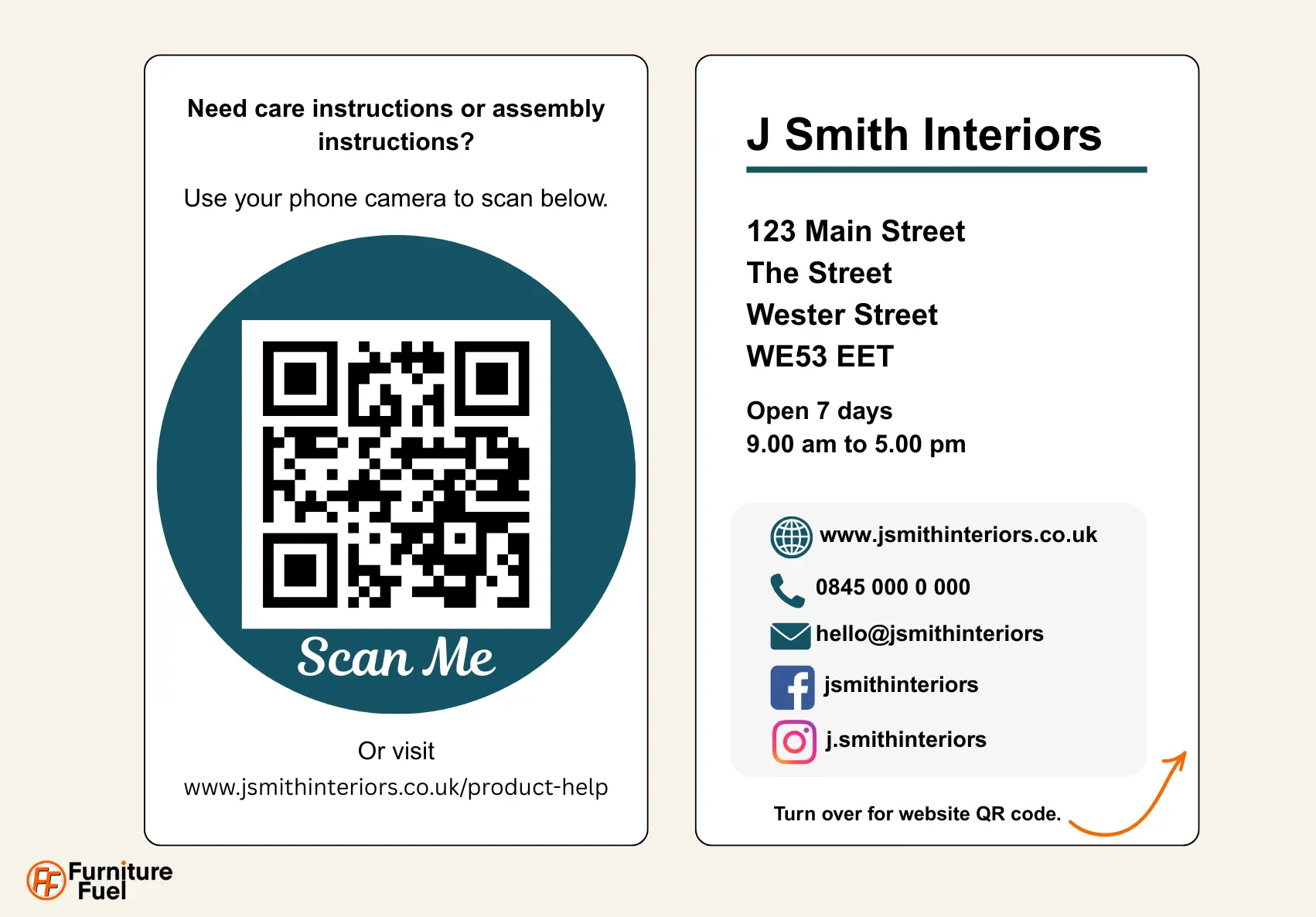
The simplest entry point is to batch-print a high volume of identical cards featuring a QR code. This code links directly to a single, permanent landing page on your website, such as yourstore.co.uk/guides or yourstore.co.uk/product-help.
- The Layout: This destination is a clean, user-friendly, permanent hub featuring a straightforward A-to-Z directory of your product ranges. If a customer scans the code on their wardrobe and clicks “M” on the page, they are instantly directed to the section with all ranges beginning with M, where they can find the Malvern Bedroom manuals.
- The Pros & Cons: This method is virtually free to implement and eliminates the nightmare of managing complex 301 redirect protocols when individual products are discontinued. The only minor trade-off is a small amount of clicking friction for the customer, who must look up their specific range from the list.
Handling Discontinued Lines
Care guides are essentially evergreen. The fundamentals of how to oil solid oak, clean velvet, or protect aniline leather do not change just because a manufacturer discontinues a specific collection.
The only files that truly expire are assembly instructions and specific dimensions. Instead of deleting old ranges from your main A-to-Z page, which clutters the interface for new buyers, place a “Discontinued & Archive” link at the bottom of the directory. This ensures that the five-year-old customer can still find their legacy PDFs without cluttering your active showroom collections.
Website Storage: Myths vs Reality
Many retailers worry that hosting hundreds of legacy PDFs will slow down their website or bloat their server costs.
A standard, well-optimised four-page assembly or care PDF is roughly 500 KB to 1.5 MB in size. If an independent retailer discontinues 200 products over five years, that equates to roughly 300 MB of total data.
To put that into perspective:
- 300 MB is less than the file size of just three or four high-resolution, uncompressed hero images sitting on your current homepage.
- Standard modern mid range web hosting packages offer anywhere from 10 GB to 50 GB+ of storage.
- Keeping five years of product history active uses less than 3% of a basic, entry-level hosting allowance.
Protecting Site Speed
The second worry and real danger to a website isn’t the physical storage space; it is site speed and backend clutter. If you bloat your primary media library with thousands of old files, or if your e-commerce platform (like Shopify or WooCommerce) mistakenly indexes these archived files in your live store search, it can degrade the user experience for new buyers, as well as possibly affect crawl budget.
To prevent this, you can deploy one of two simple solutions:
- Solution A: The Subdomain Asset Store. Instead of uploading PDFs directly into your main website’s media library, store them on a separate subdomain (e.g., assets.yourstore.co.uk/guides/). This completely isolates the old files from your primary e-commerce system. A customer downloading a five-year-old guide via their QR card puts zero load on your live checkout or product pages, keeping your main site fast and responsive.
- Solution B: Cloud Storage Redirection. If you want absolutely no technical fuss, your website doesn’t need to host the files at all. The “Discontinued Archive” button on your landing page can simply link out to a securely locked, read-only folder on Google Drive or Dropbox Business. These platforms handle 100% of the storage and bandwidth for free or at a small cost, depending on the level of storage; your website doesn’t get bogged down, and the customer still gets an instant, reliable download.
The Range-Level Portal
The next step up is to print distinct batches of cards specific to your core product collections (e.g., one batch for the Hampton Oak range, another for the Chesterfield Leather range).
- The Layout: The QR code points directly to a dedicated range page, such as yourstore.co.uk/hampton. This tailored landing page contains the assembly PDFs, care manuals, and exact dimensions only for that specific family of furniture.
- The Pros & Cons: This approach feels incredibly premium and bespoke to the consumer. For the retailer, it strikes the perfect operational balance: you only have to manage 15 to 20 range-level URLs rather than trying to handle thousands of individual product SKUs.
The Flexible QR Approach
For retailers looking for total operational agility, this option utilises a dedicated platform to generate dynamic QR codes managed via a central dashboard.
- The Layout: The physical card printed points to a permanent, shortened redirect link controlled by the software. This approach significantly reduces the need to manage complex 301 redirects for individual product pages, particularly as ranges are discontinued over time; you simply log into the dashboard and instantly swap out the destination URL behind the scenes.
- The Pros & Cons: This approach offers a high degree of flexibility and acts as a safeguard against future website or platform changes. However, it does introduce a degree of reliance on third-party software, meaning retailers should weigh the ongoing cost and platform dependency against the operational convenience.
Always-On Product Support
As briefly mentioned earlier, you don’t need a complicated system to make this work. A single, simple QR card solution that leads the customer directly to an evergreen care guide is sometimes all it takes. This ensures they always have an immediate, at-hand reference on how to care for their upholstery or timber, how to safely move the item, and how to maintain its condition for years to come. Ultimately, this means they still feel fully supported by you, and it proves to the consumer that you are genuinely interested in helping them keep their furniture looking great for years to come.
More Than Just Instructions
You aren’t just limited to providing troubleshooting manuals. You can leverage those tiny cards to drive future revenue and word-of-mouth marketing.
Turning Customers into Referrers
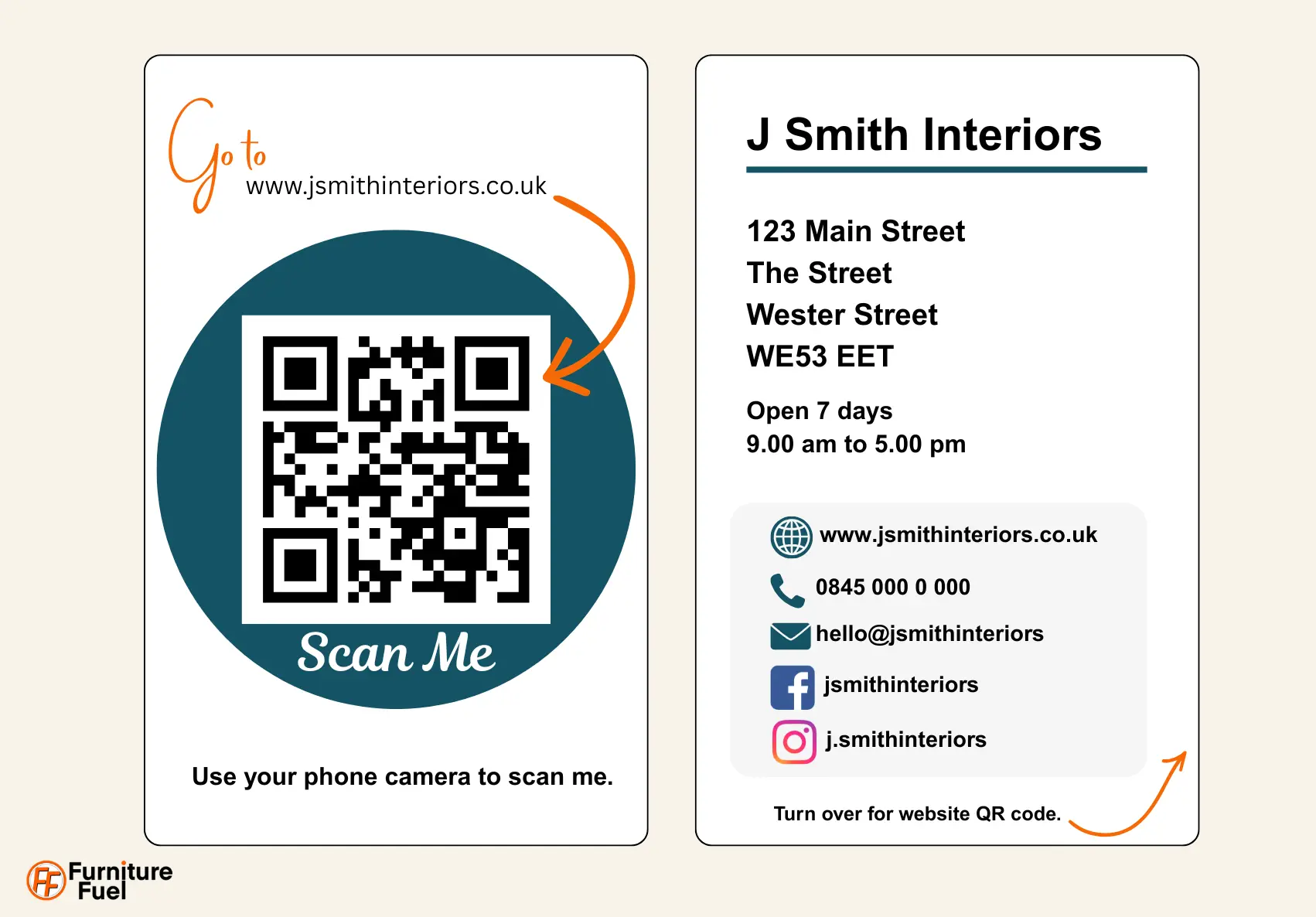
Many Independent retailers rely heavily on word-of-mouth, but memory fades over time. Consider this common scenario: a customer has friends over for dinner, and a guest says, “Oh, I absolutely love your sideboard, where did you get it from?” Instead of the owner racking their brain trying to remember the name of an independent showroom they visited three or four years ago, they can simply say, “Actually, the retailer’s details are right here. If you scan this little code on the back, it takes you straight to their website.”
Subtle Upsell Opportunities
This approach is best suited to option 2 (the Range-Level Portal) rather than a generic A-to-Z page. If a customer scans the QR code that came with their new Oak bed, the landing page doesn’t have to show only assembly guides; it can feature a discreet section titled “Complete the Bedroom,” showcasing the matching Oak bedside tables, chests of drawers, and wardrobes, accompanied by a direct link to purchase.
A Note of Caution: When a customer scans a code because they are actively looking for help or assembly instructions, even a soft product sell can sometimes leave a sour taste. It is important to treat this element as an experiment. Retailers should test whether featuring complementary products drives genuine incremental sales or whether it causes friction during a customer’s support journey.
Self-Service vs Human Support
Furniture transit and home life happen. Parts get lost during house moves, or cabinet hinges begin to sag. Naturally, a customer would scan the QR code to check the instruction guides for part sizes or adjustment manuals.
Including a “Spare Parts & Help” button on your landing page seems like an obvious way to cut down on customer service inquiries, but the operational reality is rarely that simple. If a customer fills out a digital form requesting a replacement bolt for a legacy product, you face a logistical bottleneck. You might not have it in stock, meaning you have to request it from the supplier, a process that is rarely quick for you or the consumer.
This is where true product knowledge trumps basic automation. If you know that a specific dining table uses a standard M8 x 30mm bolt, it is often vastly more efficient to pick up the phone and direct the customer to a local Screwfix or B&Q. They can resolve their problem that afternoon, rather than waiting weeks for a supplier shipment.
While a QR code can provide the initial gateway for help, it will never entirely replace the telephone. A quick, proactive phone call to explain their options will always be faster—and far more personal—than a protracted chain of back-and-forth support emails.
Simplifying Warranty & Product Records
Every independent retailer has experienced this scenario. A customer walks into the showroom looking to match a piece of furniture they bought eight years ago. They show you a grainy photo on their phone. If you are lucky, it’s easily identifiable. More often, it looks remarkably similar to four other collections you’ve stocked over the decade, and the exact range name is lost to time.
This challenge is compounded by data retention requirements. For example, HMRC guidelines typically require businesses to retain records for at least six years, while GDPR principles require that personal data is not kept longer than necessary.
In practice, many retailers choose to minimise the amount of historical customer data they actively store once these obligations are met, even though the product itself may remain in use for decades.
The solution here is the QR card working as a dual-purpose Warranty & ID Card.
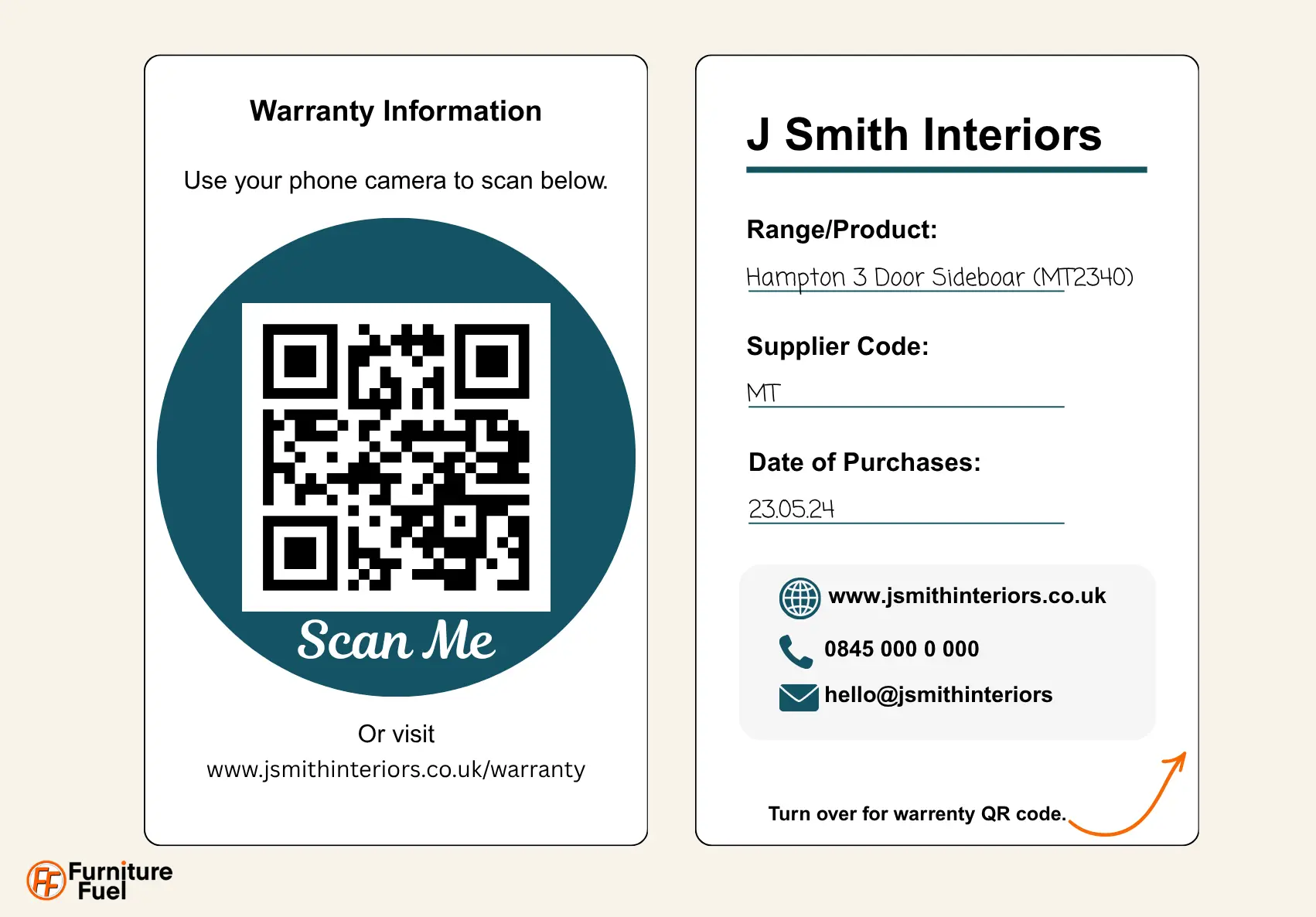
The QR card directs the customer to a simple, static landing page outlining your general terms (e.g., “Your sofa’s structural timber frame is protected for 10 years”). It provides absolute clarity without needing to pull up a unique, personalised invoice.
On the opposite side to the QR code, the card features a small, handwritten or printed text block detailing the Date of Purchase, the Range Name, and a Supplier Code.
When that customer returns to your store a decade later wanting a matching nest of tables, they don’t need you to dig through a database. They simply bring in the card, and you instantly know the exact supplier and range name, allowing you to check current availability or immediately recommend the closest visual match. It keeps your business data-compliant while providing effortless, long-term service.
Catching Issues Before They Go Public
A caution for retailers: do not use this QR card as a blind invitation to leave a Google or Trustpilot review. If a sideboard, for example, arrives with transit damage or delayed parts, and the first thing a frustrated customer sees when scanning that card for help is a bright button saying “Tell us how we did!”, you have just handed them a digital megaphone to damage your reputation.
The goal of long-term care is to catch dissatisfaction early and solve it quietly, not broadcast it.
To prevent this, you can include a dedicated “Something Not Quite Right?” card inside the pouch. It should feature a direct, reassuring message:
Thank you for purchasing your new furniture from [Your Store].
Is something not quite right? If your delivery has arrived with missing parts, transit damage, or you need immediate assembly assistance, please scan here to WhatsApp our Care Team directly. We will sort it out.
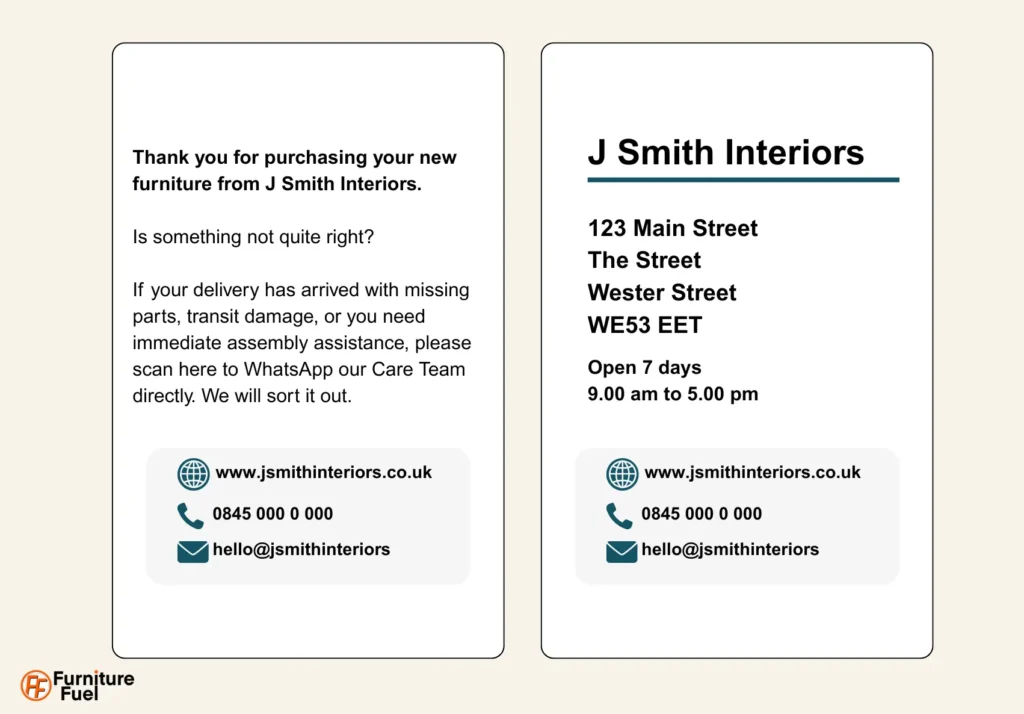
By giving an unhappy customer an instant, low-friction release valve, you catch the problem privately before they head to public review platforms.
Optionally, as highlighted in our article on building customer loyalty, sending a proactive email check-in a few days after delivery dramatically alters the customer’s perception of your brand. It gives you a controlled space to resolve lingering issues. For the customers who reply with glowing feedback? That is the exact moment you send a follow-up link asking them to share their experience publicly.
A Small Tool, Long-Term Impact
The retailers who win long-term aren’t always the ones who sell the most on day one; they’re the ones who remain useful after the sale is forgotten.
Most furniture businesses focus heavily on the purchase moment: pricing, display, and finance options. But from the customer’s perspective, ownership lasts years. Problems, questions, and maintenance needs don’t happen in-store—they happen at home, often long after the brand has faded from memory.
This is where a simple system like QR-linked support becomes more than a convenience. It becomes a form of ‘post-purchase infrastructure’. A way to stay present, useful, and trusted throughout the ownership lifecycle.
In a market where products are often similar, that ongoing utility is what separates a one-time transaction from a long-term customer relationship.
For the cost of a few pence per delivery, you can reduce reliance on long-term customer data storage, mitigate negative reviews before they surface, and take pressure off your customer service team over time. Most importantly, you secure a permanent touchpoint inside the customer’s home, keeping your showroom top-of-mind for years to come.