How Assembly Transparency Demonstrates the Value of Delivery

Jack Young
- Last Updated: 20 March 2026
The Gist — How Assembly Transparency Proves Delivery Value
By clearly showing build time and box count on product pages, furniture retailers can turn assembly required from a hidden pain into proof that delivery and installation are worth paying for, boosting trust, uptake of services, and post‑purchase satisfaction.
One Doesn’t Talk About Assembly
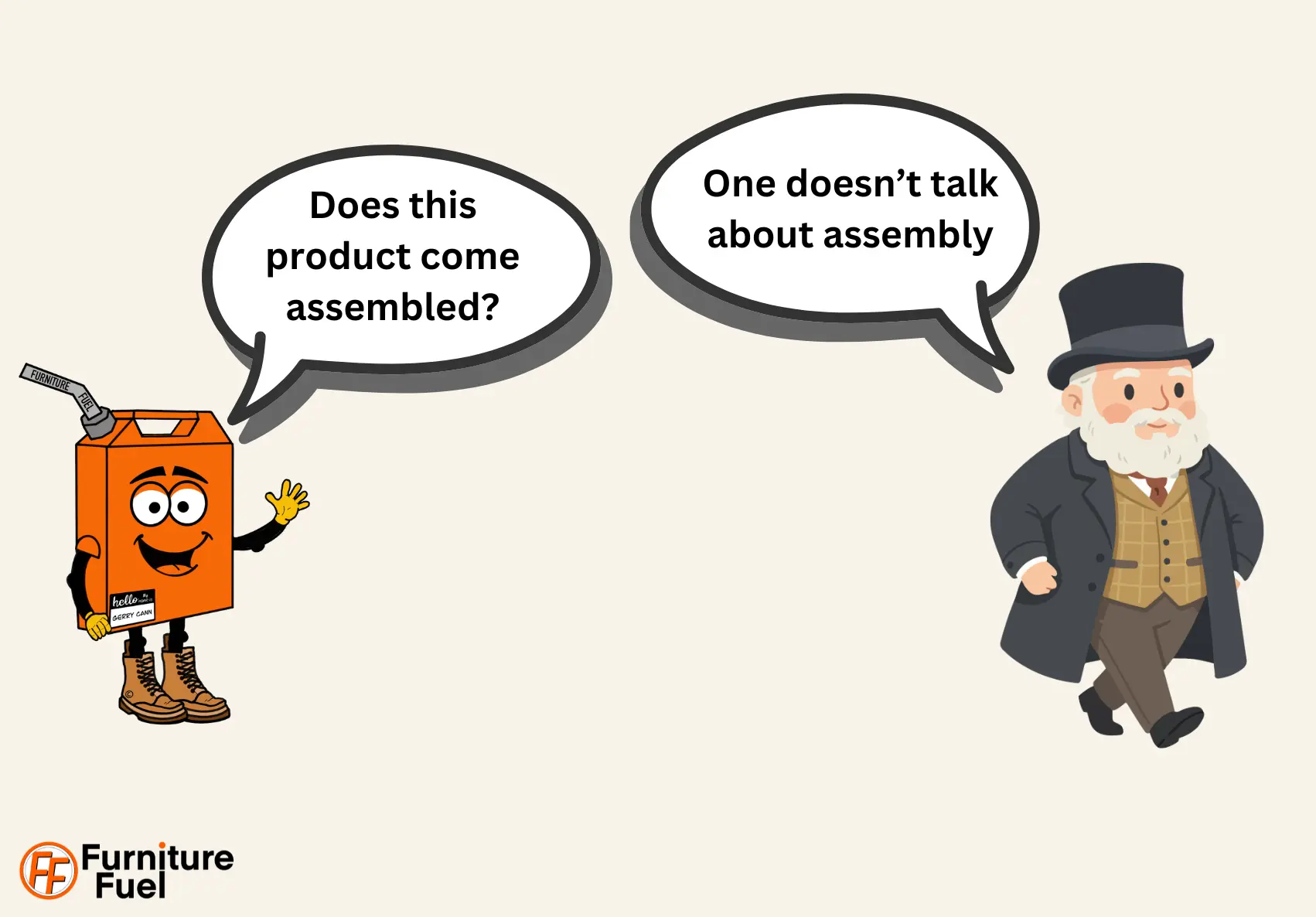
Assembly required is often treated like a dirty secret. It’s buried in the specifications, tucked away near the box dimensions. Why? Perhaps we assume the customer already knows, or we fear that pointing out the work involved will kill the sale.
But, while reducing friction is normally the name of the game for increasing conversion rate, this particular friction is a physical reality of the product. It cannot be ignored—only managed.
By hiding this friction, you are risking a poor post-purchase experience. This is extremely important because of the Peak-End Rule: the psychological fact that we judge an experience by its most intense point and its final moments.
As I’ve discussed before regarding customer loyalty, if the “End” of your customer’s journey is an unexpected, three-hour battle with a wardrobe, that frustration becomes their permanent memory of your brand.
The goal is to stop hiding that friction and instead reframe it as a demonstrator for the value your delivery and installation fees present.
Delivering an Argument-Free Afternoon... and Furniture
When customers see a delivery charge, they often view it as an additional cost rather than a value addon. To fix this, we need to remind them of the true cost of free collection.
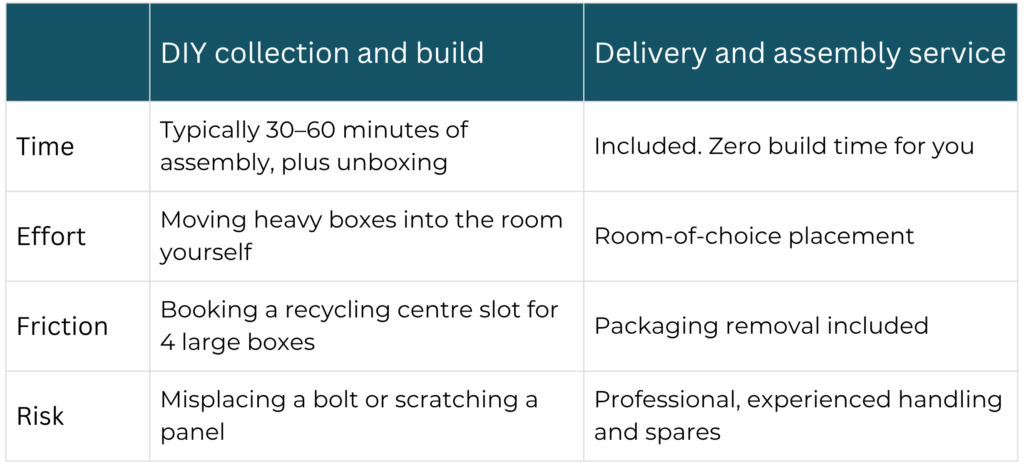
A delivery charge is normally a small price to pay compared to the customer’s time and effort. To collect and build themselves, they have to:
- Squeeze a product into a family car and hope the boot closes.
- Drive home and successfully lift a heavy item into the room of choice (hopefully not upstairs) without dropping it.
- Unwrap the item and find somewhere to store the mountain of packaging.
- Book an appointment at a local recycling centre to dispose of the cardboard.
This doesn’t even account for the inevitable “left a bit, right a bit” arguments with partners, or the interrogation that follows if something goes wrong. If they damage it during a DIY delivery, they face the subtle (or not so subtle) assessment of blame when they call for a replacement.
Sell the Solution, Not the Shipping
If you haven’t explained this on your product pages, make sure you do. Try a drop-down section titled “Why choose our delivery?” and be blunt about the value:
“We offer delivery from £59. If you’d rather not spend your previous free time squeezing furniture into a car, navigating a heavy lift, possibly up the stairs, or booking a slot at the local recycling centre to get rid of the boxes, our delivery option is for you. We handle the heavy lifting, the assembly, and the hassle. More details available on our delivery page.”
On your delivery page, you can simplify this further into a quick side‑by‑side comparison, so the value is obvious at a glance:
Not All Surprises Are Wanted
As we discussed in our pre-purchase flowchart strategy, unspoken expectations kill the sale. The risk when a customer assumes a dining table comes pre-built is that the advocacy loop is broken before the first bolt is turned.
Yes, I’ve had customers ask over the years, “oh, does it not come assembled?”, referencing a table. You and I know it doesn’t; it’s a logistical nightmare, but they necessarily don’t.
Instead, give them the data. A clear 35-minute average build icon is a Silent Salesman. It isn’t a difficulty rating (which breeds fear); it’s a commitment of time. It allows the customer to mentally prepare for their Saturday. The addition of displaying the build time alongside a box count makes that £79 delivery fee no longer look like an expense it once did, and now starts looking like insurance for an argument-free afternoon.
Remember those customers who assume everything comes pre-built? There is a hidden benefit to the box counter that proves additional value to them: it signals that the product will actually make it into their home. While they might initially dread the assembly, the sight of 3 Boxes provides the immediate relief that they won’t be struggling to get a 2-metre tabletop with legs attached through a narrow hallway or around a tight banister
Under-Promising for the Win
The “Ikea Effect” tells us that customers value products more when they’ve had a hand in creating them, if the process is successful.
By using a professional plus buffer timing (adding 25% to what your delivery team can achieve), you set the customer up for a win. When they finish the build in 25 minutes instead of the advertised 35, they feel a sense of achievement. This is where a standard assembly turns into a 5-star review: “Easier to build than expected!”
The IKEA Paradox
You might notice that the Kings of Self-Assembly don’t advertise build times on their product pages. That’s not an oversight; they simply don’t need to. For IKEA, self-assembly is part of the deal the customer has already accepted in exchange for the low price point.
We also have to acknowledge that our customers may not necessarily be IKEA customers. When someone chooses an independent over a big-box giant, they are trading a higher price point and a longer lead time for “Better Quality.”
The danger is that in the customer’s mind, price = better service, quality or both. If they’ve waited six weeks for a premium wardrobe, the last thing they may expect is to be handed an Allen key.
I’ve seen it time and again: the moment you explain why a piece is flat-packed or disassembled (usually for the safety of the furniture during transit and ease of delivery), the customer stops seeing it as a “cheap” trait and starts seeing your assembly service as a necessary investment for their new furniture.
It’s Time to Implement
Implementation Strategy
- Don’t guess the times. Use your delivery and assembly teams to log pro build times and add a realistic buffer for the end-user.
- Include a simple tool required and instructions link. Removing the friction of a mid-build search for a crosshead screwdriver.
- Place your assembly service price directly next to the build clock. Let the customer choose: My 45 minutes, or your £59?
Transparency signals competence. Even if it feels like slowing the sale at first, showing customers what’s involved builds confidence, which is what actually drives higher conversion rates and repeat purchases over time.
Testing the Strategy
You don’t need to overhaul your entire catalogue overnight. Pick five of your best-selling non-assembled items and apply the approach. Monitor the results:
- Does it increase the uptake of your assembly or premium delivery services?
- Does it show up in your reviews? Look for phrases like: “Easier to assemble than I first thought!”
You might worry that a competitor will see your 45-minute build time and dishonestly claim theirs takes 20 minutes just to get the sale. Let them.
Remember the Peak-End Rule. If they undersell the commitment, they are architecting a post-purchase disaster. When that customer is still struggling two hours later, they won’t blame their own DIY skills; they’ll blame the retailer. A review that starts with “20 minutes my backside…” is a brand-killer.
The bottom line is that transparency builds trust. Don’t be afraid to tell the customer that work is required. Instead, use that work to prove why your delivery and other services are worth every penny. In the end, you’re not just selling assembled furniture, you’re selling an argument-free afternoon, delivered with honesty and confidence. That’s what customers remember.